
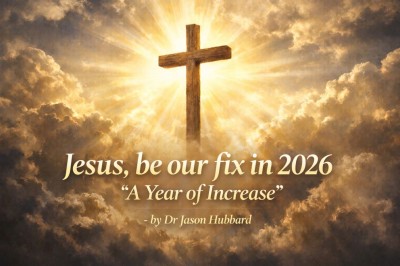
Jesus, Be Our Fix in 2026: ‘A Year of Increase’ – by Dr Jason Hubbard
As we step into 2026, our cry is simple and focused: Jesus, be our fix in 2026! In a world filled with noise, distraction, fear, and competing voices, the call of God for this season is unmistakable - fix your eyes on Jesus, the author and perfecter of our faith (Hebrews 12:2).
Can we ask this year for an increase in the revelation and beauty of Jesus?
At the foundation of all true increase is this truth: Jesus must remain our singular focus. When Jesus is our fix, everything else finds its proper alignment. May he be our fix in 2026!
 A Key to Increase: Stewarding Our Tongues
One of the practical keys to seeing supernatural increase in our lives is learning to steward our tongues. How we speak about Jesus Christ - about others, and to one another - really matters!
We are living in a time of a civil war of words, a constant swirl of competing narratives amplified by media, technology, and artificial intelligence. Discernment in these days hinges on which voices we allow to shape us. This is a season marked by the ‘battle of the voice.’ Are we speaking words of life, or words of fear? Our words can build up or tear down, create hope and healing or despair and destruction, bring blessing or cursing, bring life or bring death (Prov. 18:21) through the power of our voice!
The Fear of the Lord
Psalm 34 invites us: “Oh, taste and see that the LORD is good! Blessed is the one who takes refuge in Him.” Those who fear the Lord lack no good thing. Scripture is clear about the promises attached to the fear of the Lord:
- It is the beginning of wisdom (Proverbs 1:7)
- It brings understanding and knowledge of God (Proverbs 2:5)
- It prolongs life (Proverbs 10:27)
- It brings confidence, strength, riches, honor, and life (Proverbs 13:13; 22:4)
- It helps us overcome sin (Proverbs 16:6)
- It releases divine protection—“The angel of the LORD encamps around those who fear Him” (Psalm 34:7)
The psalmist connects the fear of the Lord directly to the tongue:
“Come, my children, listen to me; I will teach you the fear of the Lord. Whoever of you loves life and desires to see many good days, keep your tongue from evil and your lips from telling lies” – Psalm 34:11-13
When the Tongue Blocks Increase
Our tongues participate in evil through lying and deception, gossip and slander, accusation, and complaining/grumbling. Scripture warns that grumbling kept Israel from entering the promised land (2 Cor. 10). These sinful tendencies hinder the increase of God’s blessing in our lives.
This calls for a moment of confession and consecration—yielding our tongues fully to the purposes of God.
 What Our Tongues Are Meant to Do
- Praise – “I will bless the LORD at all times; His praise shall continually be in my mouth” (Psalm 34:1).
- Thanksgiving – It is God’s will that we give thanks in all things.
- Prayer – Prayer in Jesus’ name increases divine activity on the earth.
- Honor and Blessing – Speaking life over one another builds the community of faith.
Praying in the Spirit: A Pathway to Increase
Scripture reveals that praying in tongues is a powerful gift given to the Church. When we pray in tongues, we speak to God, uttering mysteries by the Spirit (1 Corinthians 14:2). Our spirit prays beyond the limits of our understanding. Tongues function as prayer, praise, and thanksgiving,
The benefits of praying in tongues include:
- Increase in personal strengthening (1 Corinthians 14:4; Jude 20)
- Increase in Spirit-led prayer, praise and thanksgiving (Romans 8, I Cor. 14)
- Increase in effective spiritual warfare (Ephesians 6:18-19)
Praying in tongues is a gateway gift - a gateway to greater revelation of Jesus just as the apostle Paul experienced profound insight while speaking in tongues more than all the Corinthian church (1 Cor. 14:18).
History bears witness to this power. Jackie Pullinger, a young British woman, ministered in the darkness of Hong Kong’s Kowloon Walled City—one of the most lawless places on earth at the time. Through persistent prayer in the Spirit and speaking in tongues, God broke addictions, delivered lives, and demonstrated His power where human ability failed. As Jackie used to share, “God does not need our ability—He needs our availability”
Jesus Must Be Proclaimed as Supreme Lord and Reigning King
 Ultimately, may we proclaim the Supremacy of Jesus with our speech -
- His absolute supremacy over all powers
- His lordship over nations, history, and every sphere of life
- His right to allegiance, obedience, and worship
Jesus is not merely the Savior of individuals, but the central hope for cities, cultures, and nations.
- He is God’s answer to injustice, idolatry, and broken systems
- Proclaiming Jesus includes declaring His reign over public life, not just private faith
- The gospel is global and historical, not just personal
As believers, let’s not just talk about what Jesus gives (forgiveness, peace, purpose, heaven) but also proclaim who Jesus is.
- Jesus is not merely the means to blessings - He is the ultimate message, the treasure, the King
- Our speech should exalt His person, glory, authority, and worth
- Proclamation flows from adoration
- Witness is strongest when it overflows from captivated hearts
- We speak because Jesus is worthy to be spoken of
 In summary, speaking about Jesus means:
- Centering everything on Christ Himself
- Proclaiming His supremacy and reign
- Letting witness flow from worship
- Using language that magnifies His glory
- Declaring Him as the hope of the nations
- Calling people to allegiance, not convenience
- Praying for his exaltation that brings transformation across peoples, cities and nations
As we fix our eyes on Jesus in 2026, walk in the fear of the Lord, steward our tongues, yield ourselves fully to the Spirit, and exalt Jesus in everything we do, say, and pray, we will see a year of supernatural increase - for His glory and our joy.
A Prayer of Blessing for 2026 -
“We proclaim over our families that 2026 is crowned with the goodness of the Lord Jesus. We declare his peace within our homes, unity in our relationships, and divine purpose guiding every decision. May Joy increase, Strength be renewed, and God’s favor surround our households like a shield. As we welcome this year, we stand on the promise of Scripture: “You crown the year with Your goodness” (Psalm 65:11). This will be a year of victory, overflow of grace, and lasting testimonies of God’s faithfulness in Christ Jesus” - Yanira Gonzales, Clamor (IPC Latin America Prayer Council) Leader
For the Supremacy of Christ in all things,
Dr. Jason Hubbard – Director
International Prayer Connect

DOWNLOAD this article HERE
The United States’ decision to withdraw from more than sixty international organisations marks a profound shift in its engagement with global cooperation. The move affects a wide range of institutions linked to humanitarian aid, public health, climate coordination, development, and international governance - many of them connected to the United Nations system. Supporters frame the decision as a reassertion of national sovereignty and fiscal accountability. Critics warn it risks weakening collective responses to crises that no nation can address alone.
The withdrawals come at a time of extraordinary global fragility. Armed conflicts continue in regions such as Sudan, Ukraine, Gaza, and the Sahel. Climate-driven disasters are increasing in scale and frequency. Millions remain displaced, food insecurity is rising, and public-health systems in low-income countries remain vulnerable to outbreaks. International coordination has often been imperfect, but it has provided shared frameworks for early warning, humanitarian access, and advocacy for those with little voice.
Humanitarian agencies caution that reduced U.S. participation may create funding gaps, limit information-sharing, and weaken diplomatic pressure where protection of civilians is most urgently needed. Faith leaders have also expressed concern that disengagement from global institutions diminishes moral leadership on issues of justice, peace, stewardship of creation, and care for the poor.
For the Church, this moment calls for discernment rather than despair. Scripture reminds us that God remains sovereign over nations and history, even amid political change. As policies shift, the people of God are invited to pray for wisdom in leadership, perseverance in humanitarian work, and renewed compassion for those who suffer - trusting that God can still work powerfully through cooperation, advocacy, and faithful witness.
Prayer Pointers
1. Pray for Humble and Courageous Leadership
Pray that those entrusted with power would lead with bowed hearts, aware that every decision goes far beyond borders and headlines. Ask God to quiet arrogance, sharpen discernment, and anchor leaders in moral courage. Pray they would listen well, and pursue justice that protects the weak and steadies the world.
“Plans fail for lack of counsel, but with many advisers they succeed.” Proverbs 20:18
2. Pray for Humanitarian Cooperation and Protection
Pray that cooperation would prevail wherever human life hangs in the balance. Ask God to strengthen humanitarian organisations, guard aid workers from harm, and keep corridors of compassion open when politics threaten to close them. Pray that mercy would not be delayed, diverted, or denied to those suffering from conflict, hunger, disease, or environmental crisis.
“Blessed are the peacemakers, for they shall be called sons of God.” Matthew 5:9
3. Pray for the Vulnerable and Overlooked
Pray for communities most at risk of being forgotten - refugees without home, families uprooted by violence, the poor whose cries go unheard, and minorities pushed aside. Ask God to be their defender and provider, to restore dignity where it has been stripped away, and to raise bold advocates who will stand in the gap with truth and compassion.
“The Lord watches over the foreigner and sustains the fatherless and the widow.” Psalm 146:9
Summary Prayer
Faithful God, steady the hands of leaders and soften their hearts. Preserve life where it is most fragile, strengthen those who serve in dangerous places, and awaken Your Church to love with courage and integrity. Let justice outlast shifting powers, and let Your purposes stand firm through every season. Amen.
Read More
- AP News — U.S. withdrawal from international organisations
https://apnews.com/article/united-nations-trump-international-organizations-withdrawal-d704fb9b444dc9cf569865d391b544a6 - White House Fact Sheet — U.S. withdrawal announcement
https://www.whitehouse.gov/fact-sheets/ - UN response and analysis (PassBlue)
https://passblue.com
Europe is entering 2026 under intensifying geopolitical strain as Russia’s war against Ukraine persists, transatlantic relations face renewed stress, and security, energy, and economic pressures converge. Russia’s continued aerial and missile attacks on Ukrainian cities and critical infrastructure, including devastating blows to energy systems in sub-zero winter conditions - have deepened humanitarian hardship and underlined the war’s brutality. The conflict’s toll has spurred emergency responses, such as the European Commission mobilising additional funds to support Ukraine’s energy needs and the ongoing search for durable peace solutions, though negotiations remain fragile. (Reuters)
European nations are also confronting broader strategic uncertainty. NATO leaders acknowledge that ending the war will require difficult decisions, even as Russia asserts that foreign forces in Ukraine would be deemed legitimate targets, complicating deterrence and defence planning. (Reuters)
Economic and energy risks persist alongside security challenges. Experts warn that threats below conventional thresholds, such as hybrid attacks on infrastructure, cyber threats, and strained relationships with key partners, could erode European stability over time. The European Union’s ban on Russian gas imports by late 2027 and coordinated efforts to diversify energy sources reflect a drive toward strategic autonomy, even as unity among member states is tested. (Wikipedia)
Amid these overlapping pressures - war, winter hardship, energy insecurity, defence debates, and economic strain - European unity and resolve are strained but remain critical. Leaders and citizens alike face extraordinary challenges that demand wisdom, resilience, and sustained cooperation in the face of uncertainty.
Prayer Pointers
1. Pray for Civilians in Ukraine and Across Europe
Pray for civilians bearing the daily cost of war - families displaced, homes darkened by power shortages, and communities bracing against cold and uncertainty. Ask God to be shelter for the exposed, strength for the weary, and comfort for those gripped by fear. Pray that help would arrive swiftly and tangibly through aid workers, local communities, and governments responding with urgency and compassion.
“The Lord is a refuge for the oppressed, a stronghold in times of trouble.” Psalm 9:9
2. Pray for Wisdom and Unity for European and NATO Leaders
Pray that European, NATO, and allied leaders would be filled with wisdom, restraint, unity, and courage as they navigate decisions with global consequences. Ask God to guide them away from fear-driven reactions toward thoughtful, collaborative choices that uphold peace and protect the vulnerable.
“If any of you lacks wisdom, let him ask God, who gives generously to all.” James 1:5
3. Pray That Peace and Diplomacy Prevail
Pray that doors for dialogue would remain open, even when trust feels fragile and tensions run high. Ask that faith, hope, and compassion prevail over mistrust, so that long-lasting peace, grounded in justice may emerge from conflict.
“Nation shall not lift up sword against nation, neither shall they learn war anymore.” Isaiah 2:4
Summary Prayer
God of refuge and truth, shelter those caught in the storm of conflict. Grant leaders’ discernment and unity, and lead nations away from fear toward reconciliation. Let compassion outshine hostility, and may Your peace, Lord, rooted in justice, take hold where war has worn the land thin. Amen.
More Information:
- Reuters – Europe faces geopolitical risks in 2026
https://www.reuters.com/world/europe/natos-rutte-says-reaching-deal-end-war-will-require-tough-choices-2026-02-03/ (Reuters) - AP News – Russian attacks on Ukraine’s power and civilian hardship
https://apnews.com/article/c10dbc6b621e196606fc79caab0eaad5 (apnews.com) - Reuters – EU bans Russian gas imports
https://en.wikipedia.org/wiki/European_Parliament_resolution_of_17_December_2025_on_phasing_out_Russian_natural_gas_imports (Wikipedia)
Venezuela remains in deep political and humanitarian crisis as the fallout from recent upheaval continues to reverberate across Latin America and beyond. In early January 2026, a U.S. military intervention captured former President Nicolás Maduro, triggering emergency meetings of the United Nations Security Council and Organization of American States amid regional alarm over sovereignty, security, and humanitarian impacts. The move drew broad international reactions, some supporting the end of Maduro’s authoritarian rule, others warning it violates international law and threatens stability in the region. (Wikipedia)
Humanitarian agencies report that nearly eight million Venezuelans currently need urgent aid as economic collapse, political repression, and insecurity persist. The refugee outflow - now among South America’s largest displacement crises, has seen millions seek refuge in neighbouring countries such as Colombia, Ecuador, Peru, and Brazil, straining host-community resources. (The United Nations Office at Geneva)
Within Venezuela, access to food, healthcare, clean water, and public services remains extremely limited. Funding shortfalls have left humanitarian operations severely under-resourced, while displaced families, children, and vulnerable groups are particularly at risk. (The United Nations in Türkiye)
Political developments continue to evolve: interim authorities have announced a sweeping amnesty and begun releasing hundreds of political prisoners, and there are efforts to reform parts of the justice and prison systems; however, long-term governance and democratic transition remain unclear and contested. (AP News)
The crisis highlights the urgent need for sustained humanitarian support, respect for human rights, and peaceful, multilateral pathways toward restoration and dignity for the Venezuelan people.
Prayer Pointers
1. Pray for Venezuelan Families in Hardship
Pray for families carrying the daily weight of scarcity. Empty shelves, fragile services, and futures clouded by uncertainty. Ask God to be near to parents choosing between necessities, to shield households from violence, and to provide daily bread in practical ways. Pray that neighbours, churches, and global partners would respond with open hands and steady compassion.
“The righteous care about justice for the poor, but the wicked have no such concern.” Proverbs 29:7
2. Pray for Wisdom and Restraint Among Leaders
Pray for those shaping decisions about Venezuela’s path forward, both within the nation and beyond its borders. Ask God to form leaders marked by humility, integrity, and restraint. Leaders who protect life rather than exploit power. Pray that diplomacy would be guided by truth, and that peace would not be pursued at the expense of justice.
“Peacemakers who sow in peace reap a harvest of righteousness.” James 3:18
3. Pray for Healing and Restoration
Pray for the slow, necessary work of healing within families, communities, and institutions worn down by years of strain. Ask God to mend what has been fractured, to rebuild trust where it has been lost. Pray that the people of Venezuela would glimpse renewal again: dignity restored, hope reborn, and peace taking root in their land.
“The Lord upholds all who fall and lifts up all who are bowed down.” Psalm 145:14
Summary Prayer
God of mercy, see those weighed down by hardship and breathe strength into weary hearts. Guide leaders toward humility and restraint, heal what has been broken, and restore dignity to the people of Venezuela. Let justice rise, let compassion endure, and let Your peace take hold where suffering has lingered too long. Amen.
More Information:
- UNHCR on Venezuela’s humanitarian situation
https://www.unhcr.org/uk/emergencies/venezuela-situation (unhcr.org) - UN analysis of ongoing aid and political context
https://turkiye.un.org/en/308083-venezuela-crisis-un-aid-effort-continues-amid-political-upheaval (The United Nations in Türkiye) - Wikipedia on international reactions to the 2026 U.S. intervention
https://en.wikipedia.org/wiki/International_reactions_to_the_2026_United_States_intervention_in_Venezuela (Wikipedia)
As the conflict between Ukraine and Russia approaches its fifth year, the war continues to impose catastrophic human and infrastructure costs across Ukraine. Russian drone and missile attacks have persisted, targeting residential areas, energy grids, and civilian infrastructure, causing deaths, injuries, and widespread blackouts — especially in eastern and southern regions. Most recently, several attacks resulted in multiple civilian deaths, including strikes in Odesa and Kharkiv, highlighting that violence still falls heavily on non-combatants.
Healthcare and humanitarian systems remain under extreme strain. The World Health Organization has launched a 2026 emergency appeal, seeking tens of millions of dollars to protect access to essential health services for hundreds of thousands of people despite continual attacks on hospitals and clinics. Nearly 3,000 verified assaults on medical facilities since 2022 have weakened care and heightened vulnerability among displaced families.
Diplomatic efforts continue but remain fragile. Trilateral peace negotiations involving the United States, Ukraine, and Russia took place in Abu Dhabi earlier this year in an attempt to break the deadlock, though key territorial disputes and security guarantees remain unresolved. These talks yielded the release of hundreds of prisoners but no ceasefire agreement, and Western sanctions packages against Russian energy and financial networks have expanded.
Meanwhile, both sides are reshaping military strategies amid grinding frontline stalemates. Casualty figures remain high, with heavy losses reported on both sides as positional warfare and attrition continue to characterise the conflict.
The human cost persists: millions remain internally displaced, energy shortages are widespread during winter, and children’s education and healthcare access continue to be disrupted. This prolonged war presses deeply on families and communities across Ukraine.
Prayer Pointers
1. Pray for Ukrainian Civilians and Vulnerable People
Pray for protection, comfort, and provision for Ukrainian civilians enduring continued attacks, displacement, and hardship. Ask God to guard families, especially the elderly, children, and those without shelter or basic services, and to fortify aid delivery in the face of violence and winter weather.
“God is our refuge and strength, an ever-present help in trouble.” — Psalm 46:1
2. Pray for Peace, Wisdom, and Restraint
Pray that global leaders, mediators, and negotiators would be filled with wisdom, restraint, and courage to pursue peace rather than escalation. Ask God to open hearts to reconciliation, strengthen diplomatic efforts, and dismantle pride and fear that fuel conflict and delay peace.
“Blessed are the peacemakers, for they shall be called children of God.” — Matthew 5:9
3. Pray for Healing of Minds and Bodies
Pray for physical healing, mental resilience, and emotional restoration for those wounded, traumatised, or living in fear. Ask God to comfort the grieving, strengthen healthcare workers, and provide resources to care for the sick, displaced, and those suffering from loss.
“He heals the brokenhearted and binds up their wounds.” — Psalm 147:3
Father God, be shelter and strength for Ukraine’s people. Guard the innocent, guide peacemakers, and bring healing to broken lives. Turn hearts toward peace, uphold mercy over vengeance, and let justice and hope rise above the gloom of war. Amen.
More Information
* WHO Humanitarian Appeal for Ukraine 2026
https://www.who.int/europe/news/item/06-02-2026-ukraine–who-seeks-us-42-million-in-2026-to-protect-health-care-as-war-enters-fifth-year 
* Al Jazeera – Key developments in the Russia-Ukraine war
https://www.aljazeera.com/news/2026/2/8/russia-ukraine-war-list-of-key-events-day-1445 
* Peace Negotiations in the Russo-Ukrainian War
https://en.wikipedia.org/wiki/Peace_negotiations_in_the_Russo-Ukrainian_war_%282022%E2%80%93present%29 
[1:15 pm, 9/2/2026] Andy Page: Page 3 - Shine! In Intro letter… Please remove apostrophe from it’s - so just ‘its’
We will be praying for the vision of 2BC, for children and youth across Indonesia and for the success of the Light of the World movie and it’s
Gospel vision.
Sudan’s civil war - now marking over 1,000 days of relentless conflict between the Sudanese Armed Forces (SAF) and the Rapid Support Forces (RSF) has plunged the nation into one of the world’s most acute humanitarian crises. Millions of civilians have been killed, displaced, or driven into life-threatening hunger amid grinding warfare across multiple fronts. Recent reports from the United Nations and humanitarian organisations describe Sudan as the site of the largest displacement and hunger crisis on Earth.
The collapse of public services including health care, clean water, and food systems, has compounded suffering. The World Food Programme warns that more than 21 million people now face acute hunger, with confirmed famine in regions such as Darfur and Kordofan, and the risk of famine spreading further where access remains blocked by insecurity. Funding shortfalls have placed lifesaving aid at risk of running dry unless urgent contributions are made.
Civilians, especially women and children, endure frequent attacks, siege conditions, and widespread abuses, including sexual violence and violations of international humanitarian law. Aid delivery continues to be dangerous and inconsistent due to blocked roads, collapsed infrastructure, and shifting battle lines. The International Rescue Committee reports that humanitarian funding has collapsed by nearly half, even as needs escalate.
Displacement is staggering: millions are internally uprooted while others seek refuge in neighbouring countries such as Chad, South Sudan, and Egypt, overwhelming fragile border communities. The crisis is a stark testament to the human cost of unending warfare, marked by hunger, disease, and relentless insecurity.
Prayer Pointers
1. Pray for Protection of Civilians
Pray for women, children, and families caught in the crossfire, whose paths are uncertain. Ask God to be their stronghold and shield, to guard them from bombardment, abuse, and displacement. Pray for His supernatural presence to encircle refugee camps and frontline communities, and that hearts everywhere would rise in compassion to meet their urgent needs.
“God is our refuge and strength, an ever-present help in trouble.” Psalm 46:1
2. Pray for Humanitarian Access and Provision
Pray that life-saving aid - food, clean water, medicine, and shelter would reach those who hunger and thirst for relief. Ask God to open safe passages for aid workers, replenish dwindling resources, and stir a global wave of generosity that sustains Sudan’s people even in the face of insecurity, blocked routes, and scarce funding.
“He satisfies the thirsty and fills the hungry with good things.” Psalm 107:9
3. Pray for Peace, Justice, and Wise Leadership
Pray that leaders, mediators, and international partners would pursue peace with integrity, wisdom, and mercy. Ask God to expose injustice, soften hardened hearts. Pray that ceasefires hold, negotiations bear fruit, and every choice honours the dignity of human life above politics or pride.
“Blessed are the peacemakers, for they shall be called children of God.” Matthew 5:9
Summary Prayer
Lord of compassion and justice, shelter Sudan’s innocent and provide for those in desperate need. Strengthen those who serve faithfully, guide leaders with wisdom, and move the world to act courageously, mercifully, and with enduring care. Amen.
More Information:
- UN Office for the Coordination of Humanitarian Affairs – Sudan
https://www.unocha.org/sudan (unocha.org) - World Food Programme – Sudan Emergency
https://www.wfp.org/emergencies/sudan-emergency (wfp.org)
• UNICEF & OCHA – 1,000 days of war briefing
https://www.who.int/news/item/09-01-2026-sudan-1000-days-of-war-deepen-the-world-s-worst-health-and-humanitarian-crisis (who.int)